
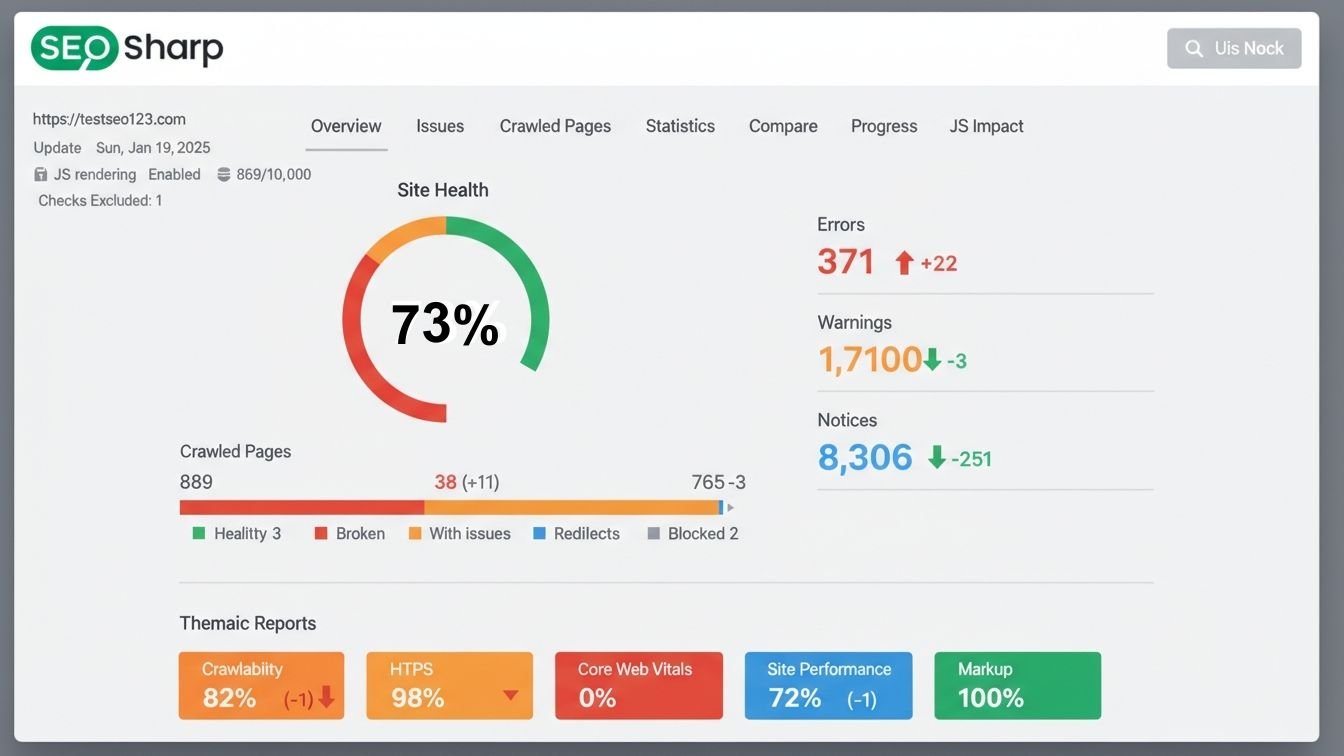
An SEO audit example shows you how experts analyze real websites to find technical problems, content issues and ranking obstacles. This complete example walks you through an actual e-commerce site audit with real numbers and specific problems you can learn from.
You’ll see exactly what happens during a professional audit through real data and clear findings. This SEO audit sample report shows technical errors, page problems, slow loading speeds and link issues with actual metrics. You’ll learn how to spot critical problems, fix them in the right order and measure your progress using methods that actually work.
What Does an SEO Audit Example Reveal?
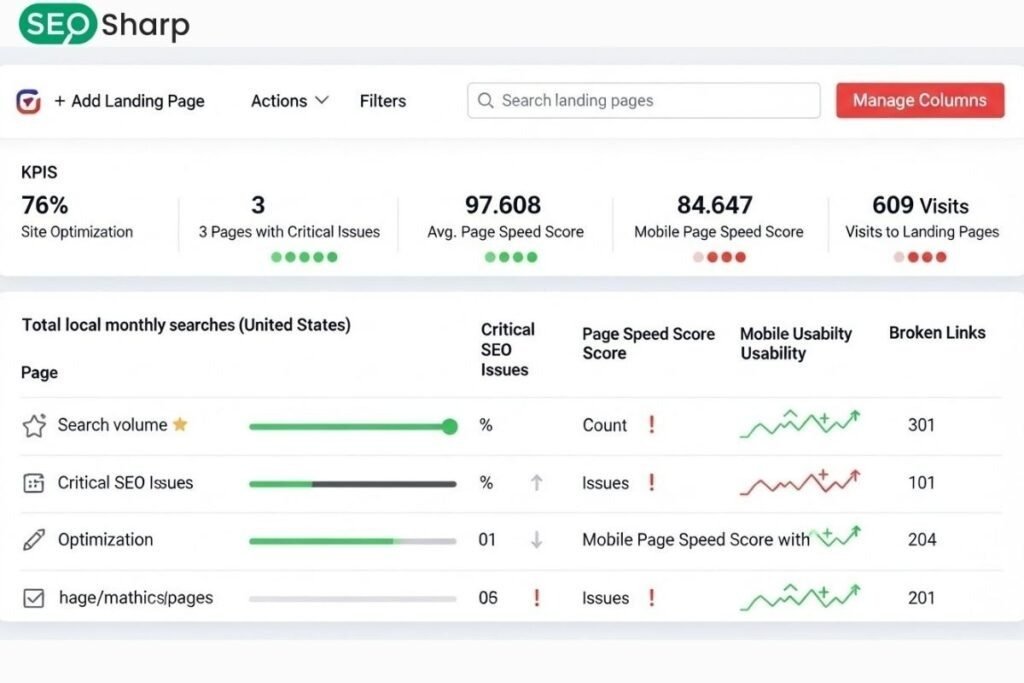
Every website audit starts by understanding where things stand right now. We’ll look at an online clothing store that sells sustainable fashion products. This site used to attract 45000 visitors every month and made $85000 in revenue. But over six months traffic dropped to just 18000 visitors with revenue falling to $34000.
The store owner noticed competitors suddenly ranking higher for keywords they used to own. Search visibility disappeared, page speed failed standards, mobile users struggled and the backlink profile showed red flags.
Audit Results for the Website
This website audit gives the site grades showing overall health. Think of it like a health checkup for your website. The site scored C overall. Technical SEO earned C+ showing issues blocking search engines.
On-page optimization scored C with meta tag problems. Performance got D grade since pages load too slowly. Mobile friendliness rated B- with usability problems. Content quality measured C showing pages need depth. Backlink profile scored D+ because toxic links hurt authority.
Technical SEO Audit Findings
The site had 847 pages but search engines only indexed 623 of them. That’s a 26% gap showing serious problems. We found 127 pages returning 404 errors wasting crawl budget. The robots.txt file accidentally blocked three product categories containing 89 pages. This mistake prevented search engines from discovering $12000 worth of monthly inventory.
The sitemap listed 1240 URLs even though the site only had 847 pages. That 46% difference confuses search engines. The sitemap included 186 pages that were redirected and 94 pages blocked by noindex tags. Professional SEO audit templates recommend organizing sitemaps by content type. This site grouped everything together without organization.
We found mixed content problems on 234 pages triggering security warnings. These pages loaded through HTTPS but pulled images through HTTP. The SSL certificate expired in 18 days. Canonical tags pointed wrong on 156 pages confusing search engines about which version to rank.
The server took 1850 milliseconds to respond way over the 200-millisecond limit. We found 43 URLs requiring three or more redirect hops. The site used 302 temporary redirects instead of 301 permanent redirects. Temporary redirects don’t pass full link authority.
On-Page SEO Analysis Results
Title tags averaged 73 characters past the 60-character limit. Search results cut these off hiding keywords. Duplicate titles appeared on 89 pages. Twelve product pages had no titles at all. Meta descriptions exceeded 160 characters on 156 pages. Duplicate descriptions appeared across 67 category pages.
Many pages used three H1 tags instead of one primary heading diluting topic focus. Subheadings jumped from H1 to H3 without H2 transitions. Product pages lacked descriptive subheadings making content hard to scan. Website seo audit template guidelines recommend clear heading structures.
We found serious keyword cannibalization where five category pages targeted identical terms creating internal competition. Product pages missed target keywords in content. Keyword density measured below 0.5%. Internal links used generic “click here” instead of descriptive keywords. We found 423 images lacking alt attributes. File names used patterns like “IMG_1234.jpg” instead of keywords.
Performance and Page Speed Results
Largest Contentful Paint measured 5.8 seconds on mobile double the 2.5-second target. Cumulative Layout Shift scored 0.23 when it should stay below 0.1. Banner ads shifted layout after loading. Interaction to Next Paint measured 340 milliseconds exceeding the 200-millisecond target. The site loaded 23 CSS files and 17 JavaScript resources. No browser caching existed. Render-blocking scripts delayed display by 1.2 seconds.
Mobile Friendliness Analysis
Tap targets measured smaller than 48×48 pixels causing accidental clicks. Text fonts measured below 16 pixels forcing zoom. Mobile Largest Contentful Paint hit 5.8 seconds. The site missed mobile-first indexing optimization opportunities.
Content Quality Assessment
Product pages averaged 180 words while competitors published 800-word descriptions. Category pages contained 120 words. The site created separate URLs for size and color variations without unique descriptions creating duplicate content. Template footer repeated across 847 pages. Blog posts hadn’t changed in 18 months.
Backlink Profile Analysis
The profile had 2847 links from 412 domains. Toxic detection flagged 186 backlinks from gambling sites and link farms. Exact match anchors made up 47% over healthy 20-30% ratios. Branded anchors only represented 23%. Competitors averaged 850 domains while this site had 412. The site lost 94 backlinks when pages got deleted without redirects.
Website Structure Analysis
URLs mixed hyphens and underscores. Professional seo site audit template standards recommend hyphens. We found 67 broken internal links and 34 orphaned pages with no internal links. These pages stay invisible to crawlers.
Structured Data Implementation
The site lacked schema markup, missing rich snippet opportunities. Product schema shows prices and ratings in results. The review schema displays star ratings. Implementing JSON-LD format following seo audit checklist pdf guidelines helps search engines show enhanced results.
Recommendations and Priority Levels
Critical Priority: Fix 127 broken pages correct robots.txt renew SSL implement canonicals.
High Priority: Compress images under 200KB upgrade hosting add unique meta tags remove 186 toxic links following seo audit checklist 2020 standards.
Medium Priority: Expand product pages reorganize internal links add breadcrumbs implement schema using seo audit report format practices.
Low Priority: Update blog content optimize image names consolidate files using seo audit template pdf and audit seo pdf resources.
Implementation Results
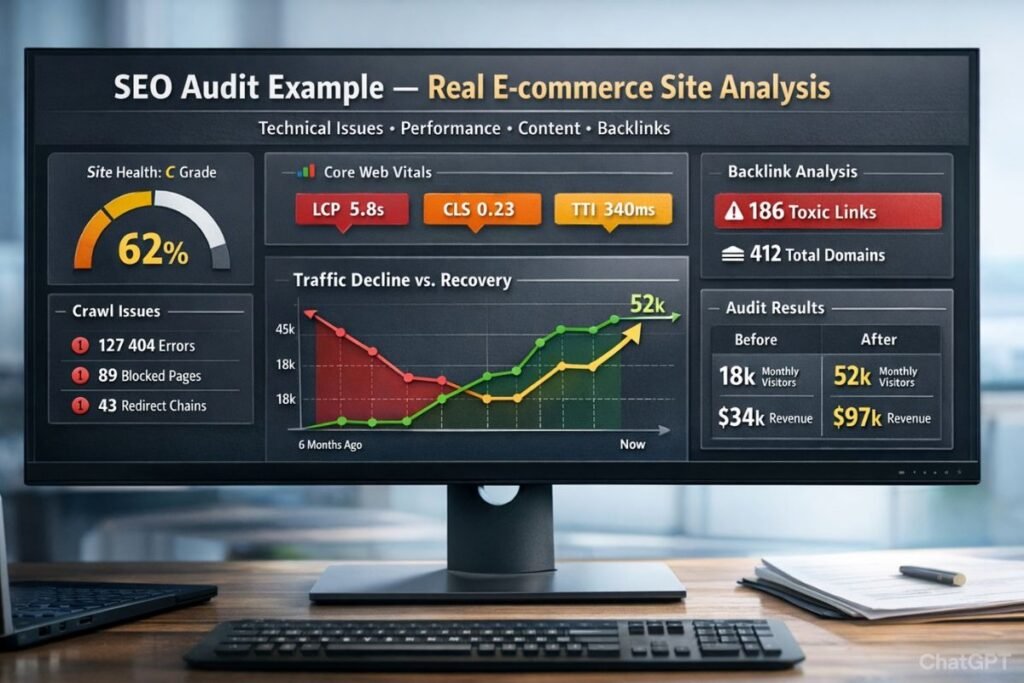
Traffic recovered from 18000 to 52000 monthly visitors (189% increase). Revenue grew from $34000 to $97000 monthly. Keyword tracking showed 47 first-page rankings. Largest Contentful Paint improved from 5.8 to 2.1 seconds.
Domain authority grew from 38 to 44. Pages indexed increased from 623 to 789. These results prove free seo audit report sample methodologies and seo audit report samples deliver measurable outcomes.
Conclusion
This SEO audit example shows how professional analysis uncovers specific problems blocking growth through technical review on-page assessment and performance evaluation.
The site recovered from 60% traffic decline by fixing crawl errors, Core Web Vitals failures, thin content and toxic backlinks using a prioritized plan. Real metrics prove this works with traffic jumping from 18000 to 52000 monthly visitors generating $63000 additional revenue.
Understanding audit structure priority frameworks and proper implementation helps you identify root causes rather than symptoms. Professional audits reveal how issues connect requiring coordinated fixes across technical infrastructure content quality and link signals.
FAQs
What tools are commonly used in an SEO audit example?
SEO audits typically use crawling tools to detect technical errors, analytics platforms to analyze user behavior and performance testing tools to measure page speed and Core Web Vitals. These tools help identify indexing problems content gaps and performance bottlenecks across the entire website
Why is an SEO audit important for e-commerce websites?
An SEO audit helps e-commerce sites identify issues affecting product visibility page speed, mobile usability and conversions. Regular audits ensure product pages rank properly, technical errors are fixed quickly and revenue opportunities are not lost due to search visibility problems.
How often should you perform an SEO audit?
Most websites benefit from a full SEO audit every six months. High-growth or competitive websites may require quarterly audits while technical checks such as crawl errors and performance should be monitored continuously.
What are the most critical issues found in SEO audit examples?
Common critical issues include crawl errors, slow page speed, duplicate content missing meta tags, weak internal linking toxic backlinks and poor mobile experience. Fixing these first typically leads to faster ranking improvements.
How long does it take to see results after an SEO audit?
Initial improvements from technical fixes can appear within a few weeks while content optimization and link building usually show measurable ranking growth within one to three months depending on competition and implementation speed.
Can small websites benefit from SEO audit examples?
Yes. Small websites gain significant value by focusing on high-impact fundamentals such as indexing page speed keyword optimization and internal linking. Even basic audits can improve visibility and traffic when implemented correctly.
What does a successful SEO audit outcome look like?
A successful audit results in improved index coverage, faster page speed, higher keyword rankings, increased organic traffic and stronger domain authority. These improvements directly contribute to better conversions and revenue growth.

2 Responses
Love the real-world approach to SEO audits. It’s easy to overlook small issues like 404 errors or toxic backlinks, but they can have such a big impact on overall rankings. The audit steps you’ve outlined are exactly what I’d recommend to any client looking to recover traffic.
Thank you, I really appreciate that.
You’re absolutely right, small issues like 404s and toxic backlinks often create the biggest ranking problems.
Glad you found the audit steps practical and useful.